Business 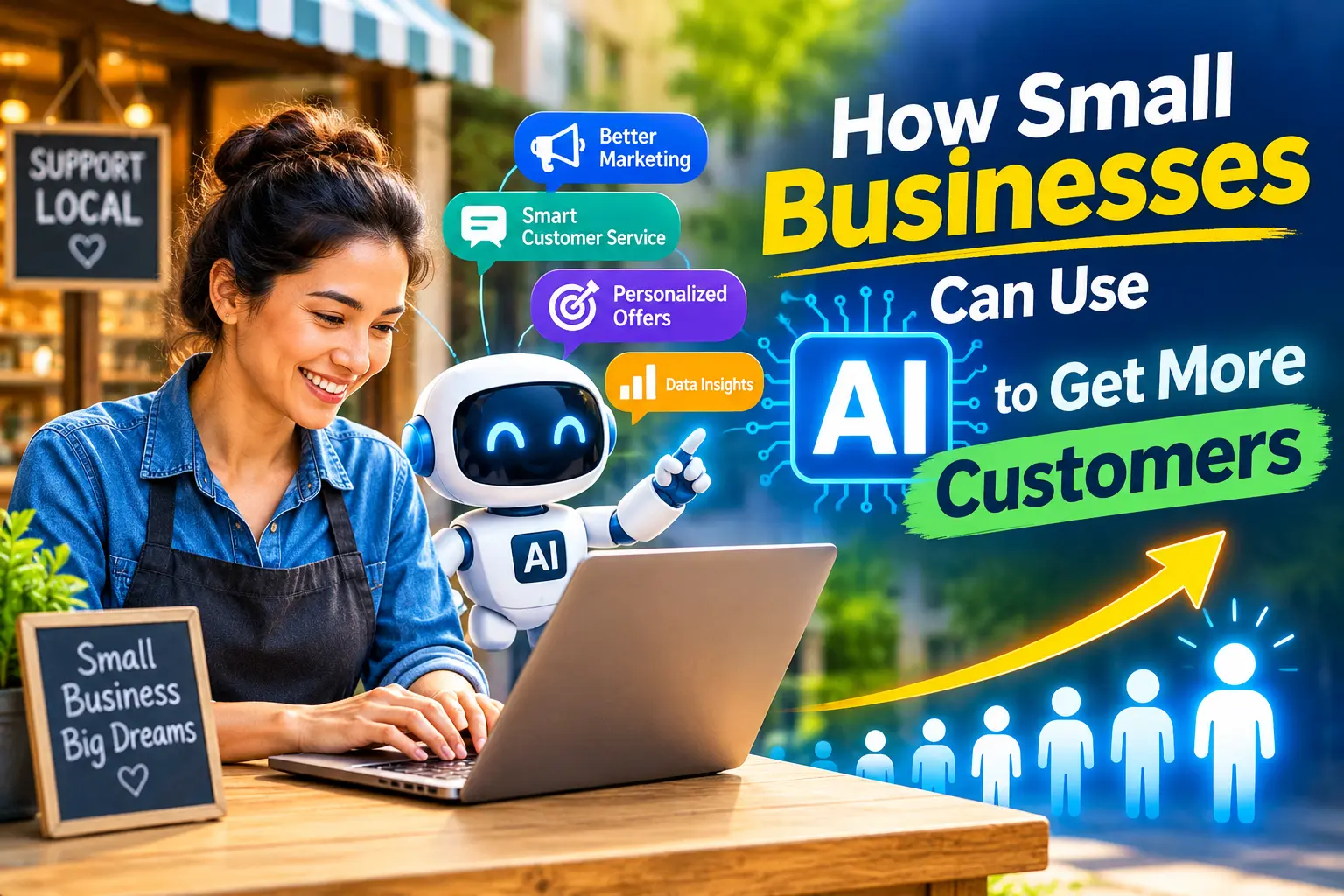
Getting more customers is one of the biggest challenges for small businesses. Whether you run a local shop, an online store, a digital marketing agency, or a service-based business, attracting new customers requires time, effort, and money.
Traditional marketing methods, such as newspaper advertisements, cold calling, and manual customer follow-ups, can be expensive and time-consuming. Fortunately, Artificial Intelligence (AI) is changing the way businesses attract, engage, and convert potential customers.
Today, small businesses can use AI-powered tools to create marketing content, automate customer support, analyze customer behavior, improve advertising campaigns, and generate qualified leads without needing a large marketing team.
The best part is that many AI tools offer free plans or affordable pricing, making them accessible to startups and small businesses.
In this guide, we will explore how small businesses can use AI to get more customers and grow their businesses more efficiently.
Content marketing is one of the most effective ways to attract potential customers. However, creating blog posts, social media updates, email newsletters, and promotional messages regularly can be challenging for small business owners.
AI writing tools can help businesses generate content ideas, write first drafts, create product descriptions, and develop marketing campaigns.
For example, a local bakery can use AI to create social media posts promoting new products. A web design company can use AI to write blog posts about website development, SEO, and online marketing.
Popular tools include:
How this gets more customers: Useful, consistent content helps businesses reach more people, build trust, and encourage potential customers to explore their products or services.
Customers often have questions before making a purchase. They may want to know your prices, business hours, delivery options, available services, or appointment schedules.
If customers cannot get answers quickly, they may choose a competitor.
AI chatbots can respond to common questions, guide visitors through your website, and help customers find relevant products or services. Depending on the platform and setup, chatbots can also collect contact details and direct complex questions to a human employee.
For example, a dental clinic can use a chatbot to answer basic questions and collect appointment requests. An online clothing store can help shoppers find products and understand its return policy.
Businesses can explore tools such as:
How this gets more customers: Faster responses reduce customer frustration, keep potential buyers engaged, and help turn website visitors into leads.
For businesses serving a specific city or neighborhood, local SEO is an important way to attract nearby customers.
When people search for terms such as "best restaurant near me," "web designer in Chennai," or "plumber in my area," they are often looking for a business they can contact soon.
AI can help small businesses improve their local SEO strategy by identifying keyword ideas, planning useful website content, drafting service pages, and organizing frequently asked questions.
You can use AI to:
For example, a digital marketing agency could publish helpful pages targeting searches related to SEO services, website development, and social media marketing in its service area.
Important: AI-generated content should be checked for accuracy and usefulness. Avoid creating many nearly identical location pages or publishing generic content simply to target keywords.
How this gets more customers: Better local visibility can help potential customers discover your business when they are actively searching for the services you provide.
Lead generation means finding people who may be interested in your products or services and giving them a reason to contact your business.
AI can support lead generation by helping businesses create landing pages, contact forms, downloadable guides, email campaigns, and targeted marketing messages.
For example, a software company could offer a free website performance checklist in exchange for a visitor's email address. A real estate agency could create a property inquiry form that collects a customer's location, budget, and preferred property type.
AI tools can also help organize incoming inquiries and prioritize leads based on relevant information, provided the business has appropriate data and a suitable system.
Useful options include:
How this gets more customers: A structured lead-generation process helps businesses identify interested prospects and guide them toward a purchase.
Customers are more likely to respond to marketing messages that match their needs and interests.
AI can help businesses personalize email campaigns, product recommendations, advertisements, and follow-up messages using relevant customer information.
For example, an online store could send product recommendations based on a customer's previous purchases. A fitness studio could send different messages to people interested in yoga, strength training, or personal coaching.
Small businesses can use AI to create different versions of a message for different customer groups rather than sending the same promotion to everyone.
However, personalization should respect customer privacy. Use information collected appropriately, obtain consent where required, and avoid making intrusive assumptions about individuals.
How this gets more customers: Relevant marketing messages can improve engagement, encourage repeat purchases, and help potential customers find products or services that fit their needs.
Many small businesses lose potential customers because they forget to follow up after an inquiry.
AI-powered email marketing and automation tools can help businesses send welcome messages, appointment reminders, abandoned-cart emails, product updates, and follow-up sequences.
For example, when a customer asks for a quotation, a business can schedule a polite follow-up email if the customer has not responded after a few days.
Email automation tools include:
AI can assist with writing subject lines, drafting email content, and suggesting variations to test. Automation rules determine when messages are sent.
How this gets more customers: Timely follow-ups help businesses stay connected with prospects, answer questions, and recover sales opportunities that might otherwise be missed.
Social media helps small businesses showcase their products, share customer experiences, and build relationships with potential buyers.
However, maintaining an active presence across multiple platforms takes time.
AI can simplify social media marketing by generating post ideas, writing captions, developing content calendars, suggesting hashtags, and helping create promotional visuals.
For example, a clothing boutique can use AI to plan a month's worth of posts featuring new arrivals, styling advice, customer testimonials, and seasonal offers.
Useful tools include:
Remember to review AI-generated content before publishing. Original photographs, authentic customer stories, and genuine demonstrations of your products can make your business more trustworthy.
How this gets more customers: Consistent and useful social media content can expand your reach, encourage engagement, and bring more people to your website or store.
Paid advertising can bring customers quickly, but poor targeting and ineffective advertisements can waste a small business's budget.
AI-powered advertising features can help businesses test different messages, identify audience patterns, optimize campaign delivery, and evaluate performance.
Platforms such as Google Ads and Meta Ads offer automated campaign features that use machine learning to support targeting and optimization.
Small businesses can also use AI to develop multiple advertisement headlines, descriptions, calls to action, and creative concepts for testing.
For example, a local gym could test advertisements focused on affordable memberships, personal training, and beginner-friendly fitness programs to discover which message attracts more inquiries.
To get better results:
1. Define your ideal customer.
2. Set a realistic advertising budget.
3. Create multiple advertisement variations.
4. Track leads, purchases, and cost per acquisition.
5. Improve campaigns based on actual results.
How this gets more customers: Better campaign management can help businesses use advertising budgets more efficiently and attract prospects who are more likely to become paying customers.
Understanding customers is essential for business growth. However, small business owners may not have the time or expertise to analyze large amounts of marketing and sales data.
AI-enabled analytics tools can help summarize website traffic, identify trends, compare marketing campaigns, and highlight potential areas for improvement.
For example, an online store may discover that many visitors view a particular product but leave before completing checkout. A service business may find that one website page generates more inquiries than other pages.
Tools such as Google Analytics and CRM reporting platforms can provide data that businesses use to make informed decisions. AI assistants may help interpret exported reports or explain trends, but conclusions should always be checked against the underlying data.
How this gets more customers: Understanding what attracts visitors and where customers drop off helps businesses improve their websites, marketing campaigns, and sales processes.
Positive customer reviews and recommendations can help potential buyers feel more confident about choosing a business.
AI can help small businesses write polite review-request messages, prepare responses to customer feedback, and develop referral campaign ideas.
For example, after completing a project, a web development company could send a thank-you email asking the customer to share an honest review. A local restaurant could invite satisfied customers to provide feedback through an appropriate review platform.
AI can also help identify common themes in feedback, such as delivery delays, pricing concerns, or excellent customer service.
However, businesses should never use AI to create fake customer reviews, impersonate customers, or misrepresent customer experiences. Ask for honest feedback and follow the rules of the relevant review platform.
How this gets more customers: Genuine reviews and word-of-mouth recommendations can strengthen credibility and help new customers feel more comfortable contacting your business.
Here is a quick overview of tools that can support different business needs.
Business need AI tool to explore Main use
Content creation ChatGPT Blog posts, ideas, and marketing copy
Graphic design Canva Social media graphics and advertisements
Customer support Tidio Chatbots and live chat
Lead management HubSpot CRM and sales pipeline
Email marketing Mailchimp Campaigns and email automation
Social media managt Buffer Scheduling and content planning
Local SEO research GSC Search performance and keyword insights
Website analytics Google Analytics Traffic and visitor behavior
Availability of AI features, integrations, and free plans varies by tool and subscription.
You do not need to adopt every AI tool at once. Start with the business problem that matters most.
Step 1: Identify your biggest challenge
Decide whether you need more website visitors, more inquiries, better customer support, or more completed sales.
Step 2: Choose one suitable AI tool
Start with a tool that solves a specific problem. Avoid paying for several tools that perform the same function.
Step 3: Automate one repetitive task
Begin with something simple, such as drafting social media posts, responding to common questions, or following up with leads.
Step 4: Measure the results
Track inquiries, qualified leads, conversion rates, sales, customer response times, and marketing costs.
Step 5: Improve and expand
Keep the workflows that produce measurable value. Refine unsuccessful campaigns before investing more money.
Although AI offers many advantages, using it without a clear strategy can produce disappointing results.
AI is most effective when combined with a clear business strategy, good customer service, and consistent measurement.
Conclusion
AI is making it easier for small businesses to compete, market their products, and reach potential customers without requiring a large team or an expensive technology budget.
From content creation and local SEO to chatbots, lead generation, email marketing, and customer analytics, AI can support nearly every stage of the customer acquisition process.
The key is to focus on practical business goals instead of adopting technology simply because it is popular. Start with one challenge, choose an affordable tool, and measure whether it helps attract more qualified leads or generate more sales.
How Small Businesses Can Use AI to Get More Customers
How Small Businesses Can Use AI to Get More Customers
Introduction
Getting more customers is one of the biggest challenges for small businesses. Whether you run a local shop, an online store, a digital marketing agency, or a service-based business, attracting new customers requires time, effort, and money.
Traditional marketing methods, such as newspaper advertisements, cold calling, and manual customer follow-ups, can be expensive and time-consuming. Fortunately, Artificial Intelligence (AI) is changing the way businesses attract, engage, and convert potential customers.
Today, small businesses can use AI-powered tools to create marketing content, automate customer support, analyze customer behavior, improve advertising campaigns, and generate qualified leads without needing a large marketing team.
The best part is that many AI tools offer free plans or affordable pricing, making them accessible to startups and small businesses.
In this guide, we will explore how small businesses can use AI to get more customers and grow their businesses more efficiently.
1. Use AI to Create Better Marketing Content
Content marketing is one of the most effective ways to attract potential customers. However, creating blog posts, social media updates, email newsletters, and promotional messages regularly can be challenging for small business owners.
AI writing tools can help businesses generate content ideas, write first drafts, create product descriptions, and develop marketing campaigns.
For example, a local bakery can use AI to create social media posts promoting new products. A web design company can use AI to write blog posts about website development, SEO, and online marketing.
Popular tools include:
- ChatGPT: Generate blog ideas, marketing copy, captions, and promotional messages.
- Google Gemini: Brainstorm content ideas and assist with research and writing.
- Grammarly: Improve grammar, clarity, and writing quality.
How this gets more customers: Useful, consistent content helps businesses reach more people, build trust, and encourage potential customers to explore their products or services.
2. Improve Customer Support With AI Chatbots
Customers often have questions before making a purchase. They may want to know your prices, business hours, delivery options, available services, or appointment schedules.
If customers cannot get answers quickly, they may choose a competitor.
AI chatbots can respond to common questions, guide visitors through your website, and help customers find relevant products or services. Depending on the platform and setup, chatbots can also collect contact details and direct complex questions to a human employee.
For example, a dental clinic can use a chatbot to answer basic questions and collect appointment requests. An online clothing store can help shoppers find products and understand its return policy.
Businesses can explore tools such as:
- Tidio
- Intercom
- Manychat
How this gets more customers: Faster responses reduce customer frustration, keep potential buyers engaged, and help turn website visitors into leads.
3. Use AI for Local SEO and Google Search Visibility
For businesses serving a specific city or neighborhood, local SEO is an important way to attract nearby customers.
When people search for terms such as "best restaurant near me," "web designer in Chennai," or "plumber in my area," they are often looking for a business they can contact soon.
AI can help small businesses improve their local SEO strategy by identifying keyword ideas, planning useful website content, drafting service pages, and organizing frequently asked questions.
You can use AI to:
- Find relevant local search keyword ideas.
- Create location-specific service pages.
- Write helpful blog posts that answer customer questions.
- Improve page titles and meta descriptions.
- Draft responses to customer reviews.
- Identify content gaps on your website.
For example, a digital marketing agency could publish helpful pages targeting searches related to SEO services, website development, and social media marketing in its service area.
Important: AI-generated content should be checked for accuracy and usefulness. Avoid creating many nearly identical location pages or publishing generic content simply to target keywords.
How this gets more customers: Better local visibility can help potential customers discover your business when they are actively searching for the services you provide.
4. Generate More Leads With AI
Lead generation means finding people who may be interested in your products or services and giving them a reason to contact your business.
AI can support lead generation by helping businesses create landing pages, contact forms, downloadable guides, email campaigns, and targeted marketing messages.
For example, a software company could offer a free website performance checklist in exchange for a visitor's email address. A real estate agency could create a property inquiry form that collects a customer's location, budget, and preferred property type.
AI tools can also help organize incoming inquiries and prioritize leads based on relevant information, provided the business has appropriate data and a suitable system.
Useful options include:
- HubSpot: Manage customer relationships, leads, and marketing activities.
- Zoho CRM: Organize contacts, sales opportunities, and follow-ups.
- ChatGpt:Develop lead magnets, landing-page copy, and outreach drafts.
How this gets more customers: A structured lead-generation process helps businesses identify interested prospects and guide them toward a purchase.
5. Personalize Marketing Messages
Customers are more likely to respond to marketing messages that match their needs and interests.
AI can help businesses personalize email campaigns, product recommendations, advertisements, and follow-up messages using relevant customer information.
For example, an online store could send product recommendations based on a customer's previous purchases. A fitness studio could send different messages to people interested in yoga, strength training, or personal coaching.
Small businesses can use AI to create different versions of a message for different customer groups rather than sending the same promotion to everyone.
However, personalization should respect customer privacy. Use information collected appropriately, obtain consent where required, and avoid making intrusive assumptions about individuals.
How this gets more customers: Relevant marketing messages can improve engagement, encourage repeat purchases, and help potential customers find products or services that fit their needs.
6. Automate Email Marketing and Follow-Ups
Many small businesses lose potential customers because they forget to follow up after an inquiry.
AI-powered email marketing and automation tools can help businesses send welcome messages, appointment reminders, abandoned-cart emails, product updates, and follow-up sequences.
For example, when a customer asks for a quotation, a business can schedule a polite follow-up email if the customer has not responded after a few days.
Email automation tools include:
- Mailchimp
- Brevo
- HubSpot
AI can assist with writing subject lines, drafting email content, and suggesting variations to test. Automation rules determine when messages are sent.
How this gets more customers: Timely follow-ups help businesses stay connected with prospects, answer questions, and recover sales opportunities that might otherwise be missed.
7. Improve Social Media Marketing With AI
Social media helps small businesses showcase their products, share customer experiences, and build relationships with potential buyers.
However, maintaining an active presence across multiple platforms takes time.
AI can simplify social media marketing by generating post ideas, writing captions, developing content calendars, suggesting hashtags, and helping create promotional visuals.
For example, a clothing boutique can use AI to plan a month's worth of posts featuring new arrivals, styling advice, customer testimonials, and seasonal offers.
Useful tools include:
- Canva: Create promotional graphics and social media designs.
- Buffer: Plan and schedule social media content.
- ChatGPT: Develop content calendars, captions, and campaign ideas.
Remember to review AI-generated content before publishing. Original photographs, authentic customer stories, and genuine demonstrations of your products can make your business more trustworthy.
How this gets more customers: Consistent and useful social media content can expand your reach, encourage engagement, and bring more people to your website or store.
8. Run Smarter Advertising Campaigns
Paid advertising can bring customers quickly, but poor targeting and ineffective advertisements can waste a small business's budget.
AI-powered advertising features can help businesses test different messages, identify audience patterns, optimize campaign delivery, and evaluate performance.
Platforms such as Google Ads and Meta Ads offer automated campaign features that use machine learning to support targeting and optimization.
Small businesses can also use AI to develop multiple advertisement headlines, descriptions, calls to action, and creative concepts for testing.
For example, a local gym could test advertisements focused on affordable memberships, personal training, and beginner-friendly fitness programs to discover which message attracts more inquiries.
To get better results:
1. Define your ideal customer.
2. Set a realistic advertising budget.
3. Create multiple advertisement variations.
4. Track leads, purchases, and cost per acquisition.
5. Improve campaigns based on actual results.
How this gets more customers: Better campaign management can help businesses use advertising budgets more efficiently and attract prospects who are more likely to become paying customers.
9. Analyze Customer Behavior With AI
Understanding customers is essential for business growth. However, small business owners may not have the time or expertise to analyze large amounts of marketing and sales data.
AI-enabled analytics tools can help summarize website traffic, identify trends, compare marketing campaigns, and highlight potential areas for improvement.
For example, an online store may discover that many visitors view a particular product but leave before completing checkout. A service business may find that one website page generates more inquiries than other pages.
Tools such as Google Analytics and CRM reporting platforms can provide data that businesses use to make informed decisions. AI assistants may help interpret exported reports or explain trends, but conclusions should always be checked against the underlying data.
How this gets more customers: Understanding what attracts visitors and where customers drop off helps businesses improve their websites, marketing campaigns, and sales processes.
10. Encourage More Customer Reviews and Referrals
Positive customer reviews and recommendations can help potential buyers feel more confident about choosing a business.
AI can help small businesses write polite review-request messages, prepare responses to customer feedback, and develop referral campaign ideas.
For example, after completing a project, a web development company could send a thank-you email asking the customer to share an honest review. A local restaurant could invite satisfied customers to provide feedback through an appropriate review platform.
AI can also help identify common themes in feedback, such as delivery delays, pricing concerns, or excellent customer service.
However, businesses should never use AI to create fake customer reviews, impersonate customers, or misrepresent customer experiences. Ask for honest feedback and follow the rules of the relevant review platform.
How this gets more customers: Genuine reviews and word-of-mouth recommendations can strengthen credibility and help new customers feel more comfortable contacting your business.
Best AI Tools for Small Businesses
Here is a quick overview of tools that can support different business needs.
Business need AI tool to explore Main use
Content creation ChatGPT Blog posts, ideas, and marketing copy
Graphic design Canva Social media graphics and advertisements
Customer support Tidio Chatbots and live chat
Lead management HubSpot CRM and sales pipeline
Email marketing Mailchimp Campaigns and email automation
Social media managt Buffer Scheduling and content planning
Local SEO research GSC Search performance and keyword insights
Website analytics Google Analytics Traffic and visitor behavior
Availability of AI features, integrations, and free plans varies by tool and subscription.
How to Start Using AI in Your Small Business
You do not need to adopt every AI tool at once. Start with the business problem that matters most.
Step 1: Identify your biggest challenge
Decide whether you need more website visitors, more inquiries, better customer support, or more completed sales.
Step 2: Choose one suitable AI tool
Start with a tool that solves a specific problem. Avoid paying for several tools that perform the same function.
Step 3: Automate one repetitive task
Begin with something simple, such as drafting social media posts, responding to common questions, or following up with leads.
Step 4: Measure the results
Track inquiries, qualified leads, conversion rates, sales, customer response times, and marketing costs.
Step 5: Improve and expand
Keep the workflows that produce measurable value. Refine unsuccessful campaigns before investing more money.
Common Mistakes to Avoid When Using AI
Although AI offers many advantages, using it without a clear strategy can produce disappointing results.
- Publishing unedited content: Always review AI-generated information for accuracy, originality, and relevance.
- Ignoring customer relationships: AI should support personal service rather than eliminate meaningful human interaction.
- Using too many tools: Start small and choose tools that fit your workflow and budget.
- Expecting instant results: SEO, brand awareness, and customer trust often take time to develop.
- Ignoring data privacy: Protect customer information and follow applicable privacy and marketing rules.
- Focusing on vanity metrics: Views and likes are useful, but qualified leads, conversions, and profitable sales matter more.
AI is most effective when combined with a clear business strategy, good customer service, and consistent measurement.
Conclusion
AI is making it easier for small businesses to compete, market their products, and reach potential customers without requiring a large team or an expensive technology budget.
From content creation and local SEO to chatbots, lead generation, email marketing, and customer analytics, AI can support nearly every stage of the customer acquisition process.
The key is to focus on practical business goals instead of adopting technology simply because it is popular. Start with one challenge, choose an affordable tool, and measure whether it helps attract more qualified leads or generate more sales.