online course 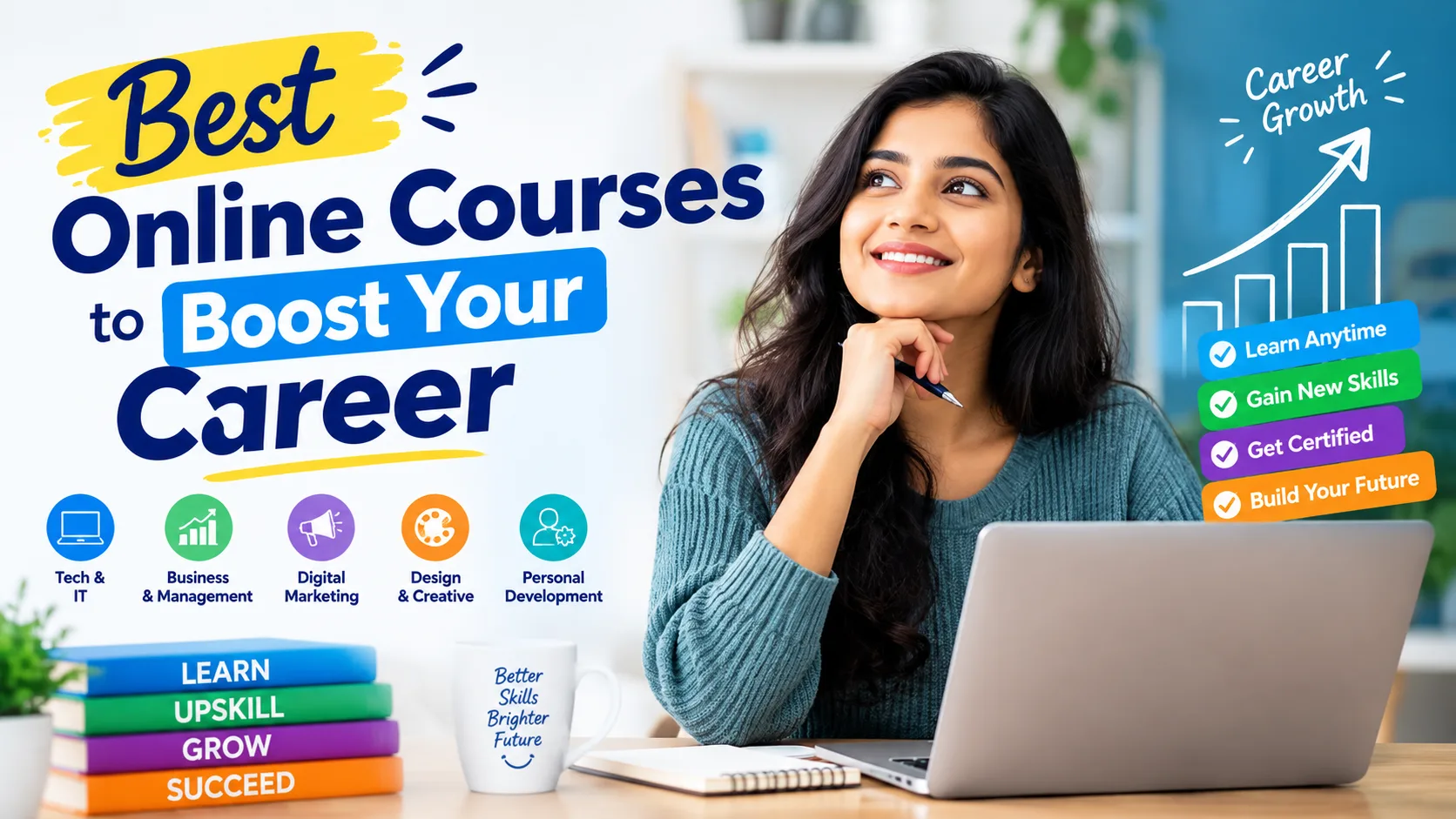
The job market is changing rapidly in 2026, and professionals need to continuously upgrade their skills to stay competitive. Whether you are a student, a job seeker, a working professional, or an entrepreneur, learning new skills can help you discover better career opportunities, improve your earning potential, and achieve your professional goals.
Online courses make learning more accessible than ever. You can study from home, learn at your own pace, and earn certificates in fields such as artificial intelligence, digital marketing, programming, data analytics, cybersecurity, and business management.
In this article, we will explore the best online courses to boost your career in 2026, the skills employers are looking for, and how to choose the right course for your future.
Traditional education provides a strong foundation, but many industries now require practical, up-to-date skills. Online learning helps bridge this gap by providing flexible and affordable training.
Here are some benefits of online courses:
The best approach is to choose a course that matches your career goals and provides opportunities to apply what you learn.
Artificial intelligence is transforming businesses, education, healthcare, marketing, software development, and many other industries. Understanding AI tools and their practical applications can help professionals work more efficiently and discover new career opportunities.
AI courses may cover generative AI, prompt engineering, machine learning fundamentals, AI-assisted automation, and responsible AI usage.
Skills you can learn:
Applying AI to business and productivity workflows
Career opportunities:AI specialist, AI application developer, automation specialist, AI-enabled marketing professional, and machine learning engineer with additional technical training.
Recommended platforms:Coursera, DeepLearning.AI, and Google Cloud Skills Boost.
Best for:Students, business owners, technology professionals, marketers, and people interested in emerging technologies.
Digital marketing is an important skill for businesses that want to reach customers online. Companies need professionals who understand search engines, social media, online advertising, content creation, and website analytics.
A digital marketing course can help you learn how to attract visitors, generate leads, build brand awareness, and measure marketing performance.
Skills you can learn:
Career opportunities:Digital marketing executive, SEO specialist, social media manager, PPC specialist, content marketer, and freelance marketing consultant.
Recommended platforms:Google Skillshop, HubSpot Academy, Semrush Academy, and Coursera.
Best for:Students, entrepreneurs, freelancers, content creators, and professionals interested in marketing.
Businesses use data to understand customer behavior, monitor performance, and make better decisions. Data analytics helps professionals turn raw information into useful insights.
Beginner courses often introduce spreadsheets, SQL, data visualization, and analytical thinking. Advanced courses may cover Python, statistical analysis, and more complex data workflows.
Skills you can learn:
Career opportunities:Data analyst, business analyst, reporting analyst, operations analyst, and business intelligence analyst.
Recommended platforms: Google Career Certificates, Coursera, Microsoft Learn, and Data Camp.
Best for: Graduates, finance professionals, business professionals, and people who enjoy working with numbers and solving problems.
Web development remains a useful career skill because businesses need websites, online stores, web applications, and digital platforms.
Beginners can start with HTML, CSS, and JavaScript before progressing to frontend frameworks, backend programming, databases, and application deployment.
Skills you can learn:
Career opportunities: Web developer, frontend developer, backend developer, full-stack developer, and freelance website designer.
Recommended platforms:freeCodeCamp, The Odin Project, Coursera, and Udemy.
Best for: Students, aspiring developers, freelancers, and people interested in building websites or software products.
As organizations rely more heavily on digital systems, protecting information and computer networks has become increasingly important. Cybersecurity courses introduce the methods used to identify vulnerabilities, reduce risks, and protect systems from attacks.
Beginners should build a foundation in networking, operating systems, security principles, and ethical practices before pursuing specialized training.
Skills you can learn:
Career opportunities: Security analyst, SOC analyst, cybersecurity support specialist, and information security professional.
Recommended platforms: Cisco Networking Academy, Microsoft Learn, Google Career Certificates, and Coursera.
Best for: IT students, technical support professionals, networking enthusiasts, and people interested in information security.
Cloud computing allows businesses to run applications, store data, and manage computing resources through cloud platforms. Knowledge of cloud services can be useful for software developers, IT administrators, data professionals, and infrastructure engineers.
Skills you can learn:
Career opportunities: Cloud support associate, cloud administrator, cloud engineer, and cloud solutions architect with suitable experience.
Recommended platforms:AWS Skill Builder, Microsoft Learn, and Google Cloud Skills Boost.
Best for: IT graduates, system administrators, developers, and networking professionals.
Project management skills are valuable across industries because organizations need people who can plan work, coordinate teams, manage budgets, and deliver projects on time.
Courses may cover traditional project management, Agile practices, Scrum, risk management, and project planning tools.
Skills you can learn:
Career opportunities: Project coordinator, project manager, operations coordinator, Scrum team member, and program support professional.
Recommended platforms: Coursera, PMI resources, and Atlassian University.
Best for: Working professionals, team leaders, engineers, and people moving into management roles.
User interface (UI) and user experience (UX) design focus on making websites, mobile applications, and digital products attractive, accessible, and easy to use.
A good UI/UX course combines design principles with research, prototyping, usability testing, and practical projects.
Skills you can learn:
Career opportunities: UI designer, UX designer, product designer, web designer, and interaction designer.
Recommended platforms: Google Career Certificates, Coursera, Interaction Design Foundation, and Figma learning resources.
Best for: Creative students, graphic designers, web designers, and people interested in digital product development.
Financial knowledge can help professionals understand business performance, prepare reports, manage budgets, and make informed decisions. It is useful for both finance careers and entrepreneurship.
Skills you can learn:
Career opportunities:Accounts executive, financial analyst, finance associate, bookkeeping professional, and business operations analyst.
Recommended platforms: Coursera, edX, and Microsoft Learn for relevant spreadsheet skills.
Best for: Commerce students, accounting professionals, entrepreneurs, and people interested in finance.
Technical expertise alone is not always enough to succeed professionally. Communication, presentation, writing, and teamwork can influence how effectively you work with colleagues, customers, and managers.
Online communication courses help learners improve professional interactions and build confidence.
Skills you can learn:
Career opportunities: These skills can support careers in sales, customer service, management, consulting, administration, and almost every other professional field.
Recommended platforms: British Council learning resources, Coursera, LinkedIn Learning, and edX.
Best for: Students, job seekers, fresh graduates, and working professionals.
With so many courses available, selecting one can be challenging. Follow these steps to make a better decision.
Decide whether you want to get your first job, earn a promotion, change careers, start freelancing, or build your own business. Your goal should guide your learning choices.
Review job descriptions for roles that interest you. Identify the skills, tools, and qualifications employers commonly request.
If you are a beginner, choose an introductory course. Build your foundation before moving to advanced topics.
Courses with assignments, case studies, exercises, and portfolio projects help you demonstrate your skills to potential employers or clients.
Some platforms offer free learning materials, while others charge for assessments, certificates, or full access. Compare the total cost before enrolling.
Apply what you learn by creating a website, analyzing a dataset, designing an app prototype, or developing a marketing campaign. A strong portfolio can help demonstrate practical ability.
Set aside a realistic amount of time each week. Consistency is often more effective than trying to complete an entire course in a few days.
Both free and paid courses can help you develop useful skills. The best choice depends on your learning style, budget, and career objectives.
Free courses are suitable when:
Paid courses may be suitable when:
Remember that paying for a course does not guarantee a job. Practical skills, project experience, communication, and the ability to demonstrate what you know remain important.
Best Online Courses to Boost Your Career
Best Online Courses to Boost Your Career in 2026
The job market is changing rapidly in 2026, and professionals need to continuously upgrade their skills to stay competitive. Whether you are a student, a job seeker, a working professional, or an entrepreneur, learning new skills can help you discover better career opportunities, improve your earning potential, and achieve your professional goals.
Online courses make learning more accessible than ever. You can study from home, learn at your own pace, and earn certificates in fields such as artificial intelligence, digital marketing, programming, data analytics, cybersecurity, and business management.
In this article, we will explore the best online courses to boost your career in 2026, the skills employers are looking for, and how to choose the right course for your future.
Why Online Courses Are Important in 2026
Traditional education provides a strong foundation, but many industries now require practical, up-to-date skills. Online learning helps bridge this gap by providing flexible and affordable training.
Here are some benefits of online courses:
- Flexible learning: Study whenever it suits your schedule.
- Affordable education: Find courses for different budgets, including free options.
- Career advancement: Develop skills that can help you qualify for new roles.
- Industry-relevant knowledge: Learn tools and technologies used in modern workplaces.
- Professional certificates: Demonstrate your commitment to continuous learning.
- Career changes: Explore a new industry without committing immediately to a full-time degree.
The best approach is to choose a course that matches your career goals and provides opportunities to apply what you learn.
1. Artificial Intelligence and Generative AI Courses
Artificial intelligence is transforming businesses, education, healthcare, marketing, software development, and many other industries. Understanding AI tools and their practical applications can help professionals work more efficiently and discover new career opportunities.
AI courses may cover generative AI, prompt engineering, machine learning fundamentals, AI-assisted automation, and responsible AI usage.
Skills you can learn:
- Using generative AI tools effectively
- Writing and improving AI prompts
- Understanding machine learning concepts
- Automating repetitive tasks
Applying AI to business and productivity workflows
Career opportunities:AI specialist, AI application developer, automation specialist, AI-enabled marketing professional, and machine learning engineer with additional technical training.
Recommended platforms:Coursera, DeepLearning.AI, and Google Cloud Skills Boost.
Best for:Students, business owners, technology professionals, marketers, and people interested in emerging technologies.
2. Digital Marketing Courses
Digital marketing is an important skill for businesses that want to reach customers online. Companies need professionals who understand search engines, social media, online advertising, content creation, and website analytics.
A digital marketing course can help you learn how to attract visitors, generate leads, build brand awareness, and measure marketing performance.
Skills you can learn:
- Search engine optimization (SEO)
- Social media marketing
- Google Ads and paid advertising
- Content marketing
- Email marketing
- Website analytics and conversion optimization
Career opportunities:Digital marketing executive, SEO specialist, social media manager, PPC specialist, content marketer, and freelance marketing consultant.
Recommended platforms:Google Skillshop, HubSpot Academy, Semrush Academy, and Coursera.
Best for:Students, entrepreneurs, freelancers, content creators, and professionals interested in marketing.
3. Data Analytics Courses
Businesses use data to understand customer behavior, monitor performance, and make better decisions. Data analytics helps professionals turn raw information into useful insights.
Beginner courses often introduce spreadsheets, SQL, data visualization, and analytical thinking. Advanced courses may cover Python, statistical analysis, and more complex data workflows.
Skills you can learn:
- Microsoft Excel and spreadsheet analysis
- SQL for querying databases
- Python fundamentals for data analysis
- Power BI or Tableau
- Data visualization and reporting
- Statistical and problem-solving techniques
Career opportunities:Data analyst, business analyst, reporting analyst, operations analyst, and business intelligence analyst.
Recommended platforms: Google Career Certificates, Coursera, Microsoft Learn, and Data Camp.
Best for: Graduates, finance professionals, business professionals, and people who enjoy working with numbers and solving problems.
4. Web Development and Programming Courses
Web development remains a useful career skill because businesses need websites, online stores, web applications, and digital platforms.
Beginners can start with HTML, CSS, and JavaScript before progressing to frontend frameworks, backend programming, databases, and application deployment.
Skills you can learn:
- HTML and CSS for website structure and design
- JavaScript for interactive websites
- React or other frontend frameworks
- PHP, Python, or Node.js for backend development
- Database management using MySQL or other database systems
- Git, testing, and deployment fundamentals
Career opportunities: Web developer, frontend developer, backend developer, full-stack developer, and freelance website designer.
Recommended platforms:freeCodeCamp, The Odin Project, Coursera, and Udemy.
Best for: Students, aspiring developers, freelancers, and people interested in building websites or software products.
5. Cybersecurity Courses
As organizations rely more heavily on digital systems, protecting information and computer networks has become increasingly important. Cybersecurity courses introduce the methods used to identify vulnerabilities, reduce risks, and protect systems from attacks.
Beginners should build a foundation in networking, operating systems, security principles, and ethical practices before pursuing specialized training.
Skills you can learn:
- Network security fundamentals
- Threat identification and risk assessment
- Security monitoring
- Incident response basics
- Linux and networking concepts
- Security policies and best practices
Career opportunities: Security analyst, SOC analyst, cybersecurity support specialist, and information security professional.
Recommended platforms: Cisco Networking Academy, Microsoft Learn, Google Career Certificates, and Coursera.
Best for: IT students, technical support professionals, networking enthusiasts, and people interested in information security.
6. Cloud Computing Courses
Cloud computing allows businesses to run applications, store data, and manage computing resources through cloud platforms. Knowledge of cloud services can be useful for software developers, IT administrators, data professionals, and infrastructure engineers.
Skills you can learn:
- Cloud computing fundamentals
- Virtual machines and storage
- Cloud networking and security
- Application deployment
- Cloud infrastructure management
- Monitoring and cost optimization
Career opportunities: Cloud support associate, cloud administrator, cloud engineer, and cloud solutions architect with suitable experience.
Recommended platforms:AWS Skill Builder, Microsoft Learn, and Google Cloud Skills Boost.
Best for: IT graduates, system administrators, developers, and networking professionals.
7. Project Management Courses
Project management skills are valuable across industries because organizations need people who can plan work, coordinate teams, manage budgets, and deliver projects on time.
Courses may cover traditional project management, Agile practices, Scrum, risk management, and project planning tools.
Skills you can learn:
- Project planning and scheduling
- Team coordination
- Budget and resource management
- Risk identification
- Agile and Scrum fundamentals
- Project reporting and communication
Career opportunities: Project coordinator, project manager, operations coordinator, Scrum team member, and program support professional.
Recommended platforms: Coursera, PMI resources, and Atlassian University.
Best for: Working professionals, team leaders, engineers, and people moving into management roles.
8. UI/UX Design Courses
User interface (UI) and user experience (UX) design focus on making websites, mobile applications, and digital products attractive, accessible, and easy to use.
A good UI/UX course combines design principles with research, prototyping, usability testing, and practical projects.
Skills you can learn:
- User research and persona development
- Wireframing and prototyping
- Visual design principles
- Website and app usability
- Design systems
- Tools such as Figma
Career opportunities: UI designer, UX designer, product designer, web designer, and interaction designer.
Recommended platforms: Google Career Certificates, Coursera, Interaction Design Foundation, and Figma learning resources.
Best for: Creative students, graphic designers, web designers, and people interested in digital product development.
9. Accounting and Financial Analysis Courses
Financial knowledge can help professionals understand business performance, prepare reports, manage budgets, and make informed decisions. It is useful for both finance careers and entrepreneurship.
Skills you can learn:
- Accounting fundamentals
- Financial statements
- Budgeting and forecasting
- Excel for financial analysis
- Financial modelling
- Business finance and reporting
Career opportunities:Accounts executive, financial analyst, finance associate, bookkeeping professional, and business operations analyst.
Recommended platforms: Coursera, edX, and Microsoft Learn for relevant spreadsheet skills.
Best for: Commerce students, accounting professionals, entrepreneurs, and people interested in finance.
10. Communication and Business English Courses
Technical expertise alone is not always enough to succeed professionally. Communication, presentation, writing, and teamwork can influence how effectively you work with colleagues, customers, and managers.
Online communication courses help learners improve professional interactions and build confidence.
Skills you can learn:
- Business English
- Professional email writing
- Presentation skills
- Interview preparation
- Negotiation and persuasion
- Workplace communication
Career opportunities: These skills can support careers in sales, customer service, management, consulting, administration, and almost every other professional field.
Recommended platforms: British Council learning resources, Coursera, LinkedIn Learning, and edX.
Best for: Students, job seekers, fresh graduates, and working professionals.
How to Choose the Right Online Course for Your Career
With so many courses available, selecting one can be challenging. Follow these steps to make a better decision.
1. Identify Your Career Goal
Decide whether you want to get your first job, earn a promotion, change careers, start freelancing, or build your own business. Your goal should guide your learning choices.
2. Check Industry Demand
Review job descriptions for roles that interest you. Identify the skills, tools, and qualifications employers commonly request.
3. Start With the Right Difficulty Level
If you are a beginner, choose an introductory course. Build your foundation before moving to advanced topics.
4. Look for Practical Projects
Courses with assignments, case studies, exercises, and portfolio projects help you demonstrate your skills to potential employers or clients.
5. Compare Fees and Certificates
Some platforms offer free learning materials, while others charge for assessments, certificates, or full access. Compare the total cost before enrolling.
6. Build a Portfolio
Apply what you learn by creating a website, analyzing a dataset, designing an app prototype, or developing a marketing campaign. A strong portfolio can help demonstrate practical ability.
7. Follow a Consistent Study Schedule
Set aside a realistic amount of time each week. Consistency is often more effective than trying to complete an entire course in a few days.
Free vs. Paid Online Courses: Which Is Better?
Both free and paid courses can help you develop useful skills. The best choice depends on your learning style, budget, and career objectives.
Free courses are suitable when:
- You want to explore a subject before investing money.
- You need foundational knowledge.
- You prefer self-paced learning.
- You want to learn specific tools or concepts.
Paid courses may be suitable when:
- You need structured lessons and assessments.
- You want instructor feedback or additional support.
- You need guided projects or career services.
- The certificate has value for your particular career path.
Remember that paying for a course does not guarantee a job. Practical skills, project experience, communication, and the ability to demonstrate what you know remain important.